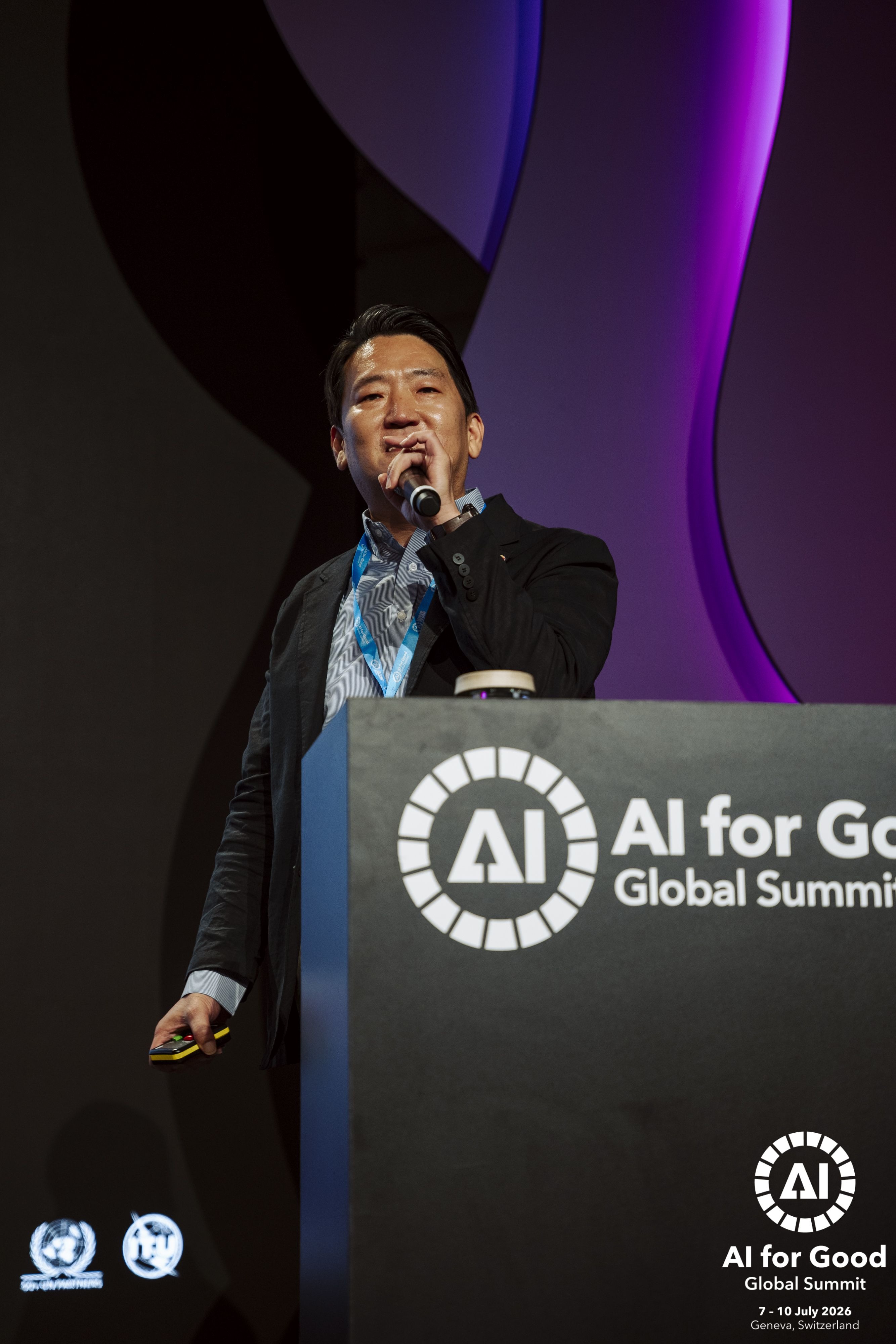
EQ4ALL CEO Kevin Lee on stage at the AI for Good Global Summit 2026 (Source: AI for Good)
On July 8, EQ4ALL CEO Kevin Lee took the stage as a speaker at the AI for Good Global Summit 2026 in Geneva, Switzerland. Here is a look at the moment we spoke about information accessibility at the world's largest AI-for-good gathering. His session was titled "AI and Information Accessibility: Bridging Communication Gaps for All." Over the 30-minute session, Kevin walked the audience through two cases that answered a single question: how can AI close the information gap?
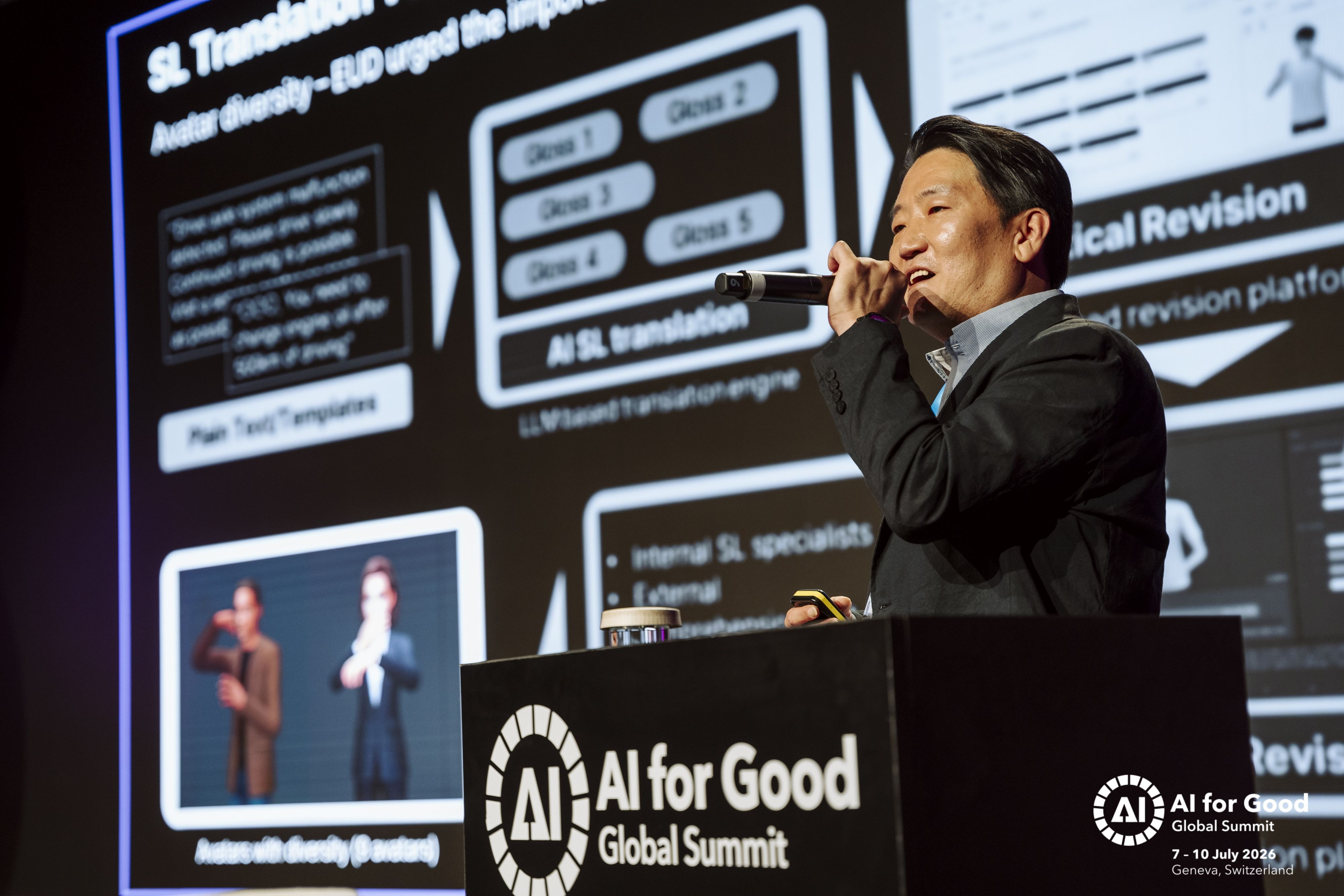
Kevin Lee introducing how EQ4ALL's AI sign language service, SignTong, works (Source: AI for Good)
He began with sign language accessibility. On screen, he showed how SignTong, EQ4ALL's AI sign language service, works — combining a large language model (LLM) with a sign language avatar so that deaf and hard-of-hearing people can understand news, emergency alerts, and public transit information in real time. He then introduced Ongl, EQ4ALL's Easy Read service, which automatically converts complex administrative documents and news into a form that people with developmental disabilities, readers with low literacy, and non-native speakers can readily understand — pairing LLM-based conversion with expert review to secure accuracy.
Kevin closed with a clear message: "The goal of AI is not technological advancement in itself, but building an environment where everyone can access information and take part in society on equal terms." It was an invitation to look beyond a race for performance and toward the question of whose life the technology actually changes.
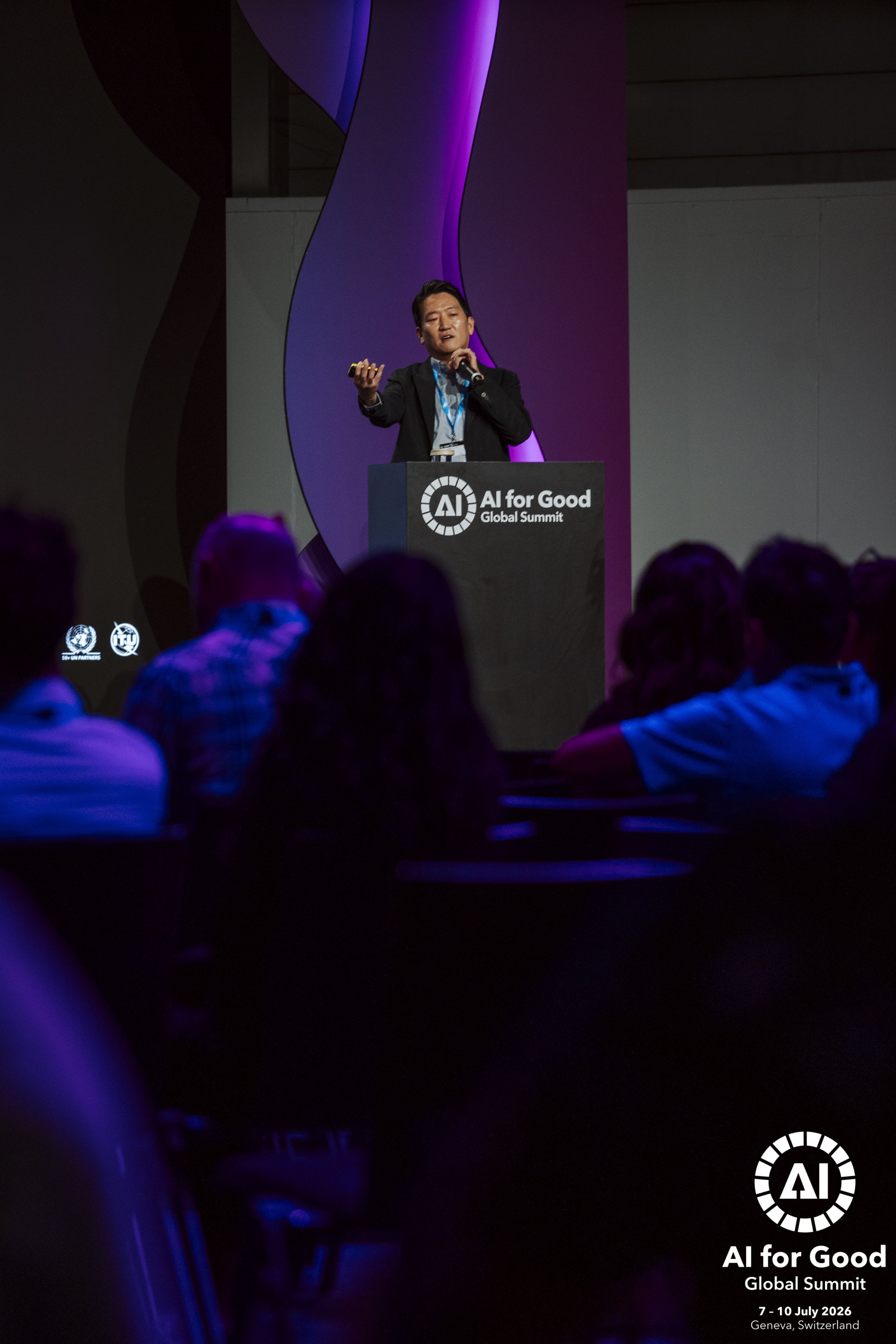
Kevin Lee delivering his session, "AI and Information Accessibility" (Source: AI for Good)
What encouraged us most were the messages of support that many shared after the session.
A consultant and startup mentor who advises on growth strategy named EQ4ALL among the companies she most wanted to highlight from the summit. Noting that our AI sign language translation platform and TV app broaden communication for deaf children and their families, reduce isolation, and help build more inclusive communities, she called it "exactly the kind of innovation that reminds us why we build technology in the first place."
Another attendee — who works in information and human rights at an international human rights organization — listed Kevin's session among the most memorable of the entire summit. Citing the summit's message that "the future of AI is no longer about what AI can do, but about what we, as humans, choose to do with it," this attendee recorded two takeaways from the talk. First, that accessibility benefits not only people with disabilities but also those with low literacy and users working across languages. Second, that AI should be judged not merely by whether it produces an output, but by whether that output can actually be understood and used by different audiences.
Many others offered personal congratulations right after the talk: an educator who wanted to learn more about how Easy Read could be applied; a tech founder who praised the accessibility work and connected it to their own field; a policy consultant who proposed collaboration, noting they were involved in similar projects; and a designer who said the sign language and Easy Read work was "truly inspiring."
Across the board, people resonated as much with the direction of the technology as with its sophistication.
Our three days in Geneva were also a moment when participants from many countries confirmed together that information accessibility is not a challenge for any single country or group alone. EQ4ALL will continue to close the information gap with AI and to build an environment where no one is left out of information.





EQ4ALL CEO Kevin Lee on stage at the AI for Good Global Summit 2026 (Source: AI for Good)
On July 8, EQ4ALL CEO Kevin Lee took the stage as a speaker at the AI for Good Global Summit 2026 in Geneva, Switzerland. Here is a look at the moment we spoke about information accessibility at the world's largest AI-for-good gathering. His session was titled "AI and Information Accessibility: Bridging Communication Gaps for All." Over the 30-minute session, Kevin walked the audience through two cases that answered a single question: how can AI close the information gap?
Kevin Lee introducing how EQ4ALL's AI sign language service, SignTong, works (Source: AI for Good)
He began with sign language accessibility. On screen, he showed how SignTong, EQ4ALL's AI sign language service, works — combining a large language model (LLM) with a sign language avatar so that deaf and hard-of-hearing people can understand news, emergency alerts, and public transit information in real time. He then introduced Ongl, EQ4ALL's Easy Read service, which automatically converts complex administrative documents and news into a form that people with developmental disabilities, readers with low literacy, and non-native speakers can readily understand — pairing LLM-based conversion with expert review to secure accuracy.
Kevin closed with a clear message: "The goal of AI is not technological advancement in itself, but building an environment where everyone can access information and take part in society on equal terms." It was an invitation to look beyond a race for performance and toward the question of whose life the technology actually changes.
Kevin Lee delivering his session, "AI and Information Accessibility" (Source: AI for Good)
What encouraged us most were the messages of support that many shared after the session.
A consultant and startup mentor who advises on growth strategy named EQ4ALL among the companies she most wanted to highlight from the summit. Noting that our AI sign language translation platform and TV app broaden communication for deaf children and their families, reduce isolation, and help build more inclusive communities, she called it "exactly the kind of innovation that reminds us why we build technology in the first place."
Another attendee — who works in information and human rights at an international human rights organization — listed Kevin's session among the most memorable of the entire summit. Citing the summit's message that "the future of AI is no longer about what AI can do, but about what we, as humans, choose to do with it," this attendee recorded two takeaways from the talk. First, that accessibility benefits not only people with disabilities but also those with low literacy and users working across languages. Second, that AI should be judged not merely by whether it produces an output, but by whether that output can actually be understood and used by different audiences.
Many others offered personal congratulations right after the talk: an educator who wanted to learn more about how Easy Read could be applied; a tech founder who praised the accessibility work and connected it to their own field; a policy consultant who proposed collaboration, noting they were involved in similar projects; and a designer who said the sign language and Easy Read work was "truly inspiring."
Across the board, people resonated as much with the direction of the technology as with its sophistication.
Our three days in Geneva were also a moment when participants from many countries confirmed together that information accessibility is not a challenge for any single country or group alone. EQ4ALL will continue to close the information gap with AI and to build an environment where no one is left out of information.