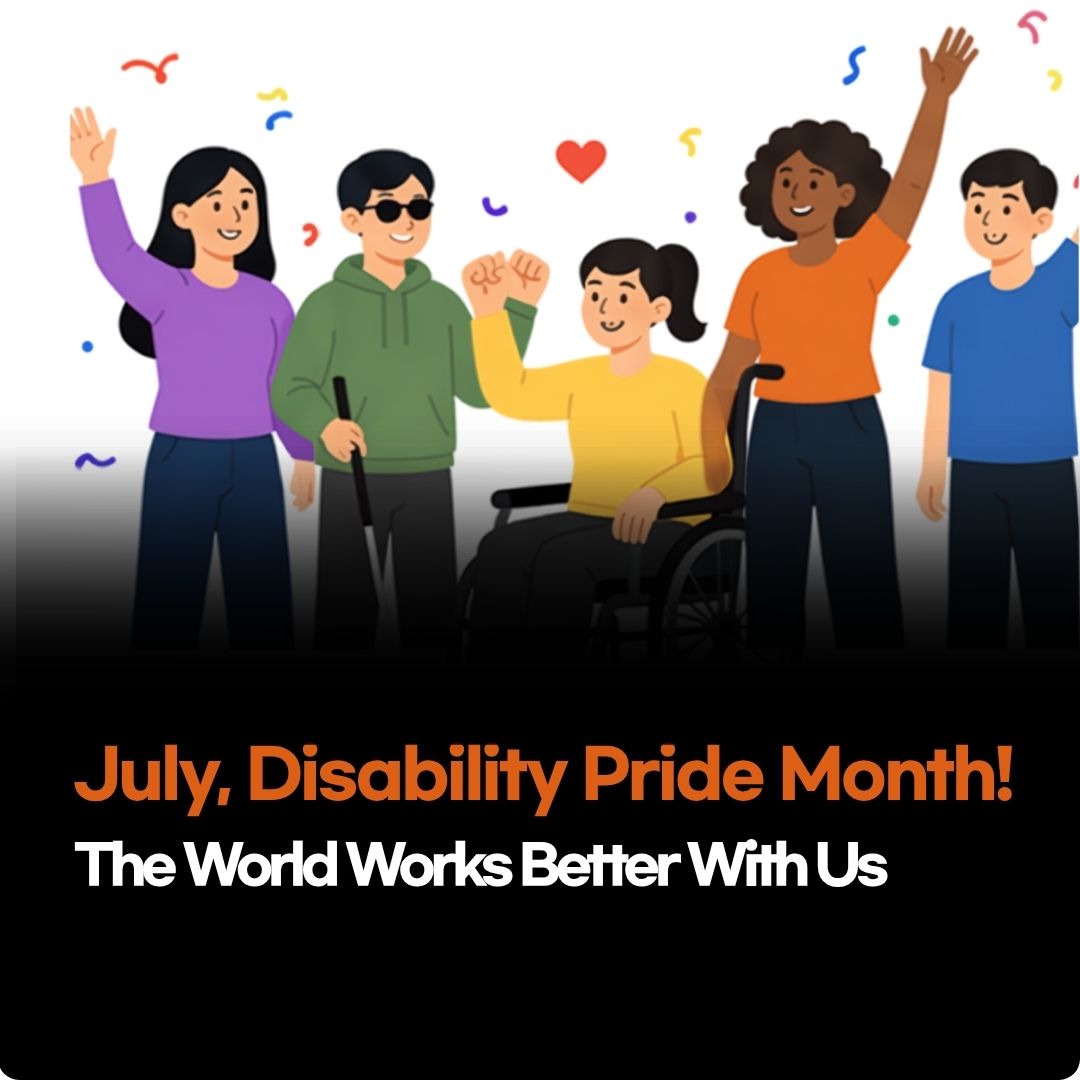
Do You Know What Kind of Month July Is?
Summer holidays and heat probably come to mind first — but July is also when the world talks about Disability Pride. The phrase may sound unfamiliar. Yet it turns out this is a story that sits closer to all of our daily lives than you might expect.
Disability Pride Month isn't a month for commemorating disability. It's closer to a month for tracing where the idea of equal participation in society came from — and the clue lies in two dates in July. July 4 honors the rights and social participation of people with intellectual and developmental disabilities. July 26 marks the signing of the Americans with Disabilities Act (ADA), the law that prohibited discrimination on the basis of disability and affirmed the right to equal participation. They come from different histories, but both look toward the same place: a society where everyone takes part on equal terms.
Where Did Disability Pride Begin?
Enacted in 1990, the ADA banned discrimination across nearly every area of life — employment, public services, telecommunications — and made reasonable accommodation a legal obligation. In effect, it put into writing the right of disabled people to live as full members of society. That shift turned disability from something to hide into something that can be shown with pride, and it lives on today in the Disability Pride movement.
Accessibility Is, in the End, for Everyone
It's easy to think of accessibility as a special consideration for disabled people. In practice, it rarely stops there.
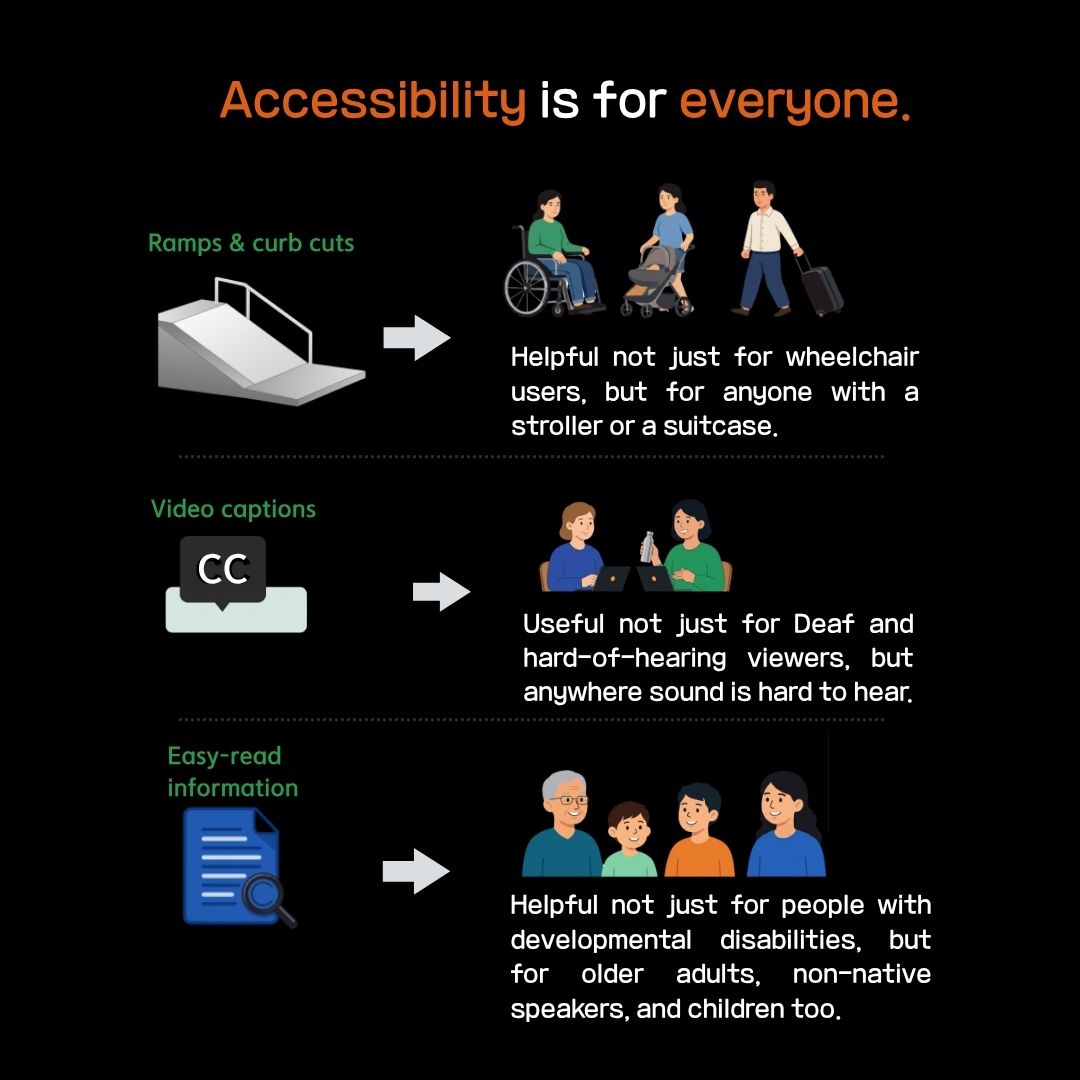
A ramp or a lowered curb helps not only wheelchair users but also a parent pushing a stroller or a traveler hauling a heavy suitcase. Captions help not only Deaf and hard-of-hearing viewers but anyone in a space where turning up the sound isn't an option. Information written in plain, easy-to-read form opens the door not only for people with developmental disabilities but for newcomers to a topic, older adults, and anyone still getting comfortable with the language.
Widening access, then, isn't a change for a few. It's a change for everyone. That's the message we want to share this year: The World Works Better With Us.
Let's Start Small
None of it has to be grand. Why not begin with three things you can do today?
First, take a look at the places you spend time — your workplace, school, or a café — and ask whether they might be a barrier to someone, then suggest a fix. Second, seek out a short film or podcast about disability, or content from disabled creators, and listen to those voices firsthand. Third, share a card-news post or an article like this one, and help widen what disability pride means.
The Smartest Way to Build a Better World
Disability pride grew out of the disability rights movement — a history of demanding rights in the face of discrimination and fighting for access, inclusion, and equality. When we see disability not as a flaw to overcome but as a natural part of human diversity, the world gets a little wider.
A society where disabled people can move, understand, and speak up without barriers isn't a favor extended to a few. It's the smartest way to build a better world.
At EQ4ALL, we work to close the gaps in access to information through technology and data. Services like SignTong, which delivers information in sign language, and Ongl, which turns information into an easy-to-read form, are how we widen access so it belongs to everyone. It's why we talk about Information for All — a society where fair opportunity is open to all. If there's a story we can build together, our door is always open.




Do You Know What Kind of Month July Is?
Summer holidays and heat probably come to mind first — but July is also when the world talks about Disability Pride. The phrase may sound unfamiliar. Yet it turns out this is a story that sits closer to all of our daily lives than you might expect.
Disability Pride Month isn't a month for commemorating disability. It's closer to a month for tracing where the idea of equal participation in society came from — and the clue lies in two dates in July. July 4 honors the rights and social participation of people with intellectual and developmental disabilities. July 26 marks the signing of the Americans with Disabilities Act (ADA), the law that prohibited discrimination on the basis of disability and affirmed the right to equal participation. They come from different histories, but both look toward the same place: a society where everyone takes part on equal terms.
Where Did Disability Pride Begin?
Enacted in 1990, the ADA banned discrimination across nearly every area of life — employment, public services, telecommunications — and made reasonable accommodation a legal obligation. In effect, it put into writing the right of disabled people to live as full members of society. That shift turned disability from something to hide into something that can be shown with pride, and it lives on today in the Disability Pride movement.
Accessibility Is, in the End, for Everyone
It's easy to think of accessibility as a special consideration for disabled people. In practice, it rarely stops there.
A ramp or a lowered curb helps not only wheelchair users but also a parent pushing a stroller or a traveler hauling a heavy suitcase. Captions help not only Deaf and hard-of-hearing viewers but anyone in a space where turning up the sound isn't an option. Information written in plain, easy-to-read form opens the door not only for people with developmental disabilities but for newcomers to a topic, older adults, and anyone still getting comfortable with the language.
Widening access, then, isn't a change for a few. It's a change for everyone. That's the message we want to share this year: The World Works Better With Us.
Let's Start Small
None of it has to be grand. Why not begin with three things you can do today?
First, take a look at the places you spend time — your workplace, school, or a café — and ask whether they might be a barrier to someone, then suggest a fix. Second, seek out a short film or podcast about disability, or content from disabled creators, and listen to those voices firsthand. Third, share a card-news post or an article like this one, and help widen what disability pride means.
The Smartest Way to Build a Better World
Disability pride grew out of the disability rights movement — a history of demanding rights in the face of discrimination and fighting for access, inclusion, and equality. When we see disability not as a flaw to overcome but as a natural part of human diversity, the world gets a little wider.
A society where disabled people can move, understand, and speak up without barriers isn't a favor extended to a few. It's the smartest way to build a better world.
At EQ4ALL, we work to close the gaps in access to information through technology and data. Services like SignTong, which delivers information in sign language, and Ongl, which turns information into an easy-to-read form, are how we widen access so it belongs to everyone. It's why we talk about Information for All — a society where fair opportunity is open to all. If there's a story we can build together, our door is always open.