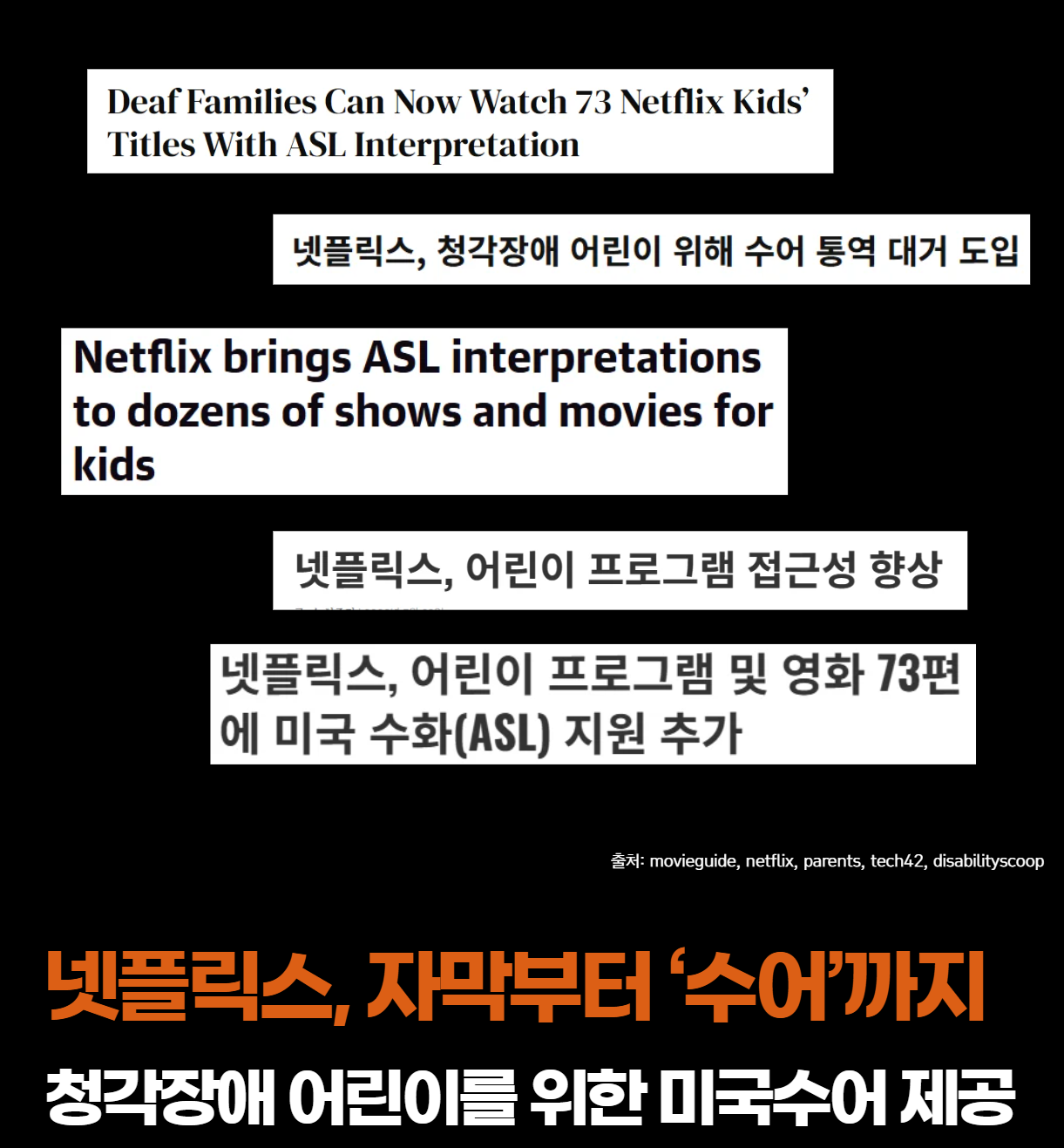
After "Captions" Comes "Sign Language"
Global streaming platform Netflix has moved beyond captions and raised the bar for accessibility a step further — into sign language. In partnership with SignUp Media, a U.S. sign language interpretation company, Netflix announced that it is bringing American Sign Language (ASL) interpretation to 73 kids' and family titles.
The lineup includes both Netflix originals and licensed content. From series like Stranger Things: Tales From '85, Pokémon Horizons, Octonauts, and The Magic School Bus Rides Again to films such as Guillermo del Toro's Pinocchio and Spider-Man: Homecoming — sign language has been added to the shows kids love most. The interpretation is delivered through a Chrome browser extension, appearing as an interpreter's video in a separate window.
There are captions — is sign language really necessary?
Seeing news like this, some may ask, "Aren't captions enough?" The answer is no.
For many Deaf people, sign language is not a mere supplementary aid but a native, first language. For Deaf children who are not yet fluent in written language especially, understanding a story through captions alone is far from easy. In fact, research has repeatedly pointed out that hearing-impaired children score lower on literacy assessments than their peers, and that captions by themselves are not enough for full comprehension. That is why the presence of a signing interpreter — laughing and gasping along on screen — turns "keeping up with the plot" into "fully sharing in the story" for a child.
The fact that this partnership begins with kids' and family content is meaningful, too. It carries the message that accessibility should extend beyond information to an equal share in joy and the opportunity to grow.
But is all sign language the same?
Here, a question arises. The sign language Netflix added this time is American Sign Language (ASL). So — is sign language the same in every country?
It isn't. Sign languages are distinct languages, each with its own grammar and expression, shaped by country and culture. Just as English and Korean are different languages, American Sign Language and Korean Sign Language (KSL) are different languages, too. So the fact that Netflix added ASL does not mean a Deaf person in Korea can immediately enjoy that story and experience in full.
What Korean Deaf audiences need is Korean Sign Language. Korean Sign Language was recognized as a language equal to written Korean under the Korean Sign Language Act of 2016. This encouraging move — a global platform beginning to find its "next step after captions" in sign language — carrying over into Korean content and public information as Korean Sign Language: that is the task before us.
May more media join in
What makes Netflix's move so welcome is that the larger the media reaching many people, the greater accessibility's ripple effect. When sign language is added to a single title, the circle of people who can share that story grows just as much.
And so we look forward to a future in which more platforms and media, in Korea and abroad, bring "the next step after captions" — the sign language of each country's Deaf community (Korean Sign Language, here at home) — into real service. At EQ4ALL, guided by our mission to "make information accessibility equal for everyone through AI technology," we walk that same path with sign language accessibility technology.
Information for everyone — toward a world where anyone can enjoy a story, we hope more will join us.
* References
- Parents.com, "Deaf Families Can Now Watch 73 Netflix Kids' Titles With ASL Interpretation" (Jul 20, 2026)
- Engadget, "Netflix brings ASL interpretations to dozens of shows and movies for kids" (Jul 20, 2026)
- IndieWire, "Netflix and ASL Company SignUp Media Are Making Hundreds of Hours of Kids Programming More Accessible" (Jul 20, 2026)
#EQ4ALL #SignTong #Accessibility #SignLanguage #DeafCommunity #InformationForEveryone #Netflix #ASL #MediaAccessibility #DisabilityInclusion #RightToInformation




After "Captions" Comes "Sign Language"
Global streaming platform Netflix has moved beyond captions and raised the bar for accessibility a step further — into sign language. In partnership with SignUp Media, a U.S. sign language interpretation company, Netflix announced that it is bringing American Sign Language (ASL) interpretation to 73 kids' and family titles.
The lineup includes both Netflix originals and licensed content. From series like Stranger Things: Tales From '85, Pokémon Horizons, Octonauts, and The Magic School Bus Rides Again to films such as Guillermo del Toro's Pinocchio and Spider-Man: Homecoming — sign language has been added to the shows kids love most. The interpretation is delivered through a Chrome browser extension, appearing as an interpreter's video in a separate window.
There are captions — is sign language really necessary?
Seeing news like this, some may ask, "Aren't captions enough?" The answer is no.
For many Deaf people, sign language is not a mere supplementary aid but a native, first language. For Deaf children who are not yet fluent in written language especially, understanding a story through captions alone is far from easy. In fact, research has repeatedly pointed out that hearing-impaired children score lower on literacy assessments than their peers, and that captions by themselves are not enough for full comprehension. That is why the presence of a signing interpreter — laughing and gasping along on screen — turns "keeping up with the plot" into "fully sharing in the story" for a child.
The fact that this partnership begins with kids' and family content is meaningful, too. It carries the message that accessibility should extend beyond information to an equal share in joy and the opportunity to grow.
But is all sign language the same?
Here, a question arises. The sign language Netflix added this time is American Sign Language (ASL). So — is sign language the same in every country?
It isn't. Sign languages are distinct languages, each with its own grammar and expression, shaped by country and culture. Just as English and Korean are different languages, American Sign Language and Korean Sign Language (KSL) are different languages, too. So the fact that Netflix added ASL does not mean a Deaf person in Korea can immediately enjoy that story and experience in full.
What Korean Deaf audiences need is Korean Sign Language. Korean Sign Language was recognized as a language equal to written Korean under the Korean Sign Language Act of 2016. This encouraging move — a global platform beginning to find its "next step after captions" in sign language — carrying over into Korean content and public information as Korean Sign Language: that is the task before us.
May more media join in
What makes Netflix's move so welcome is that the larger the media reaching many people, the greater accessibility's ripple effect. When sign language is added to a single title, the circle of people who can share that story grows just as much.
And so we look forward to a future in which more platforms and media, in Korea and abroad, bring "the next step after captions" — the sign language of each country's Deaf community (Korean Sign Language, here at home) — into real service. At EQ4ALL, guided by our mission to "make information accessibility equal for everyone through AI technology," we walk that same path with sign language accessibility technology.
Information for everyone — toward a world where anyone can enjoy a story, we hope more will join us.
* References
#EQ4ALL #SignTong #Accessibility #SignLanguage #DeafCommunity #InformationForEveryone #Netflix #ASL #MediaAccessibility #DisabilityInclusion #RightToInformation