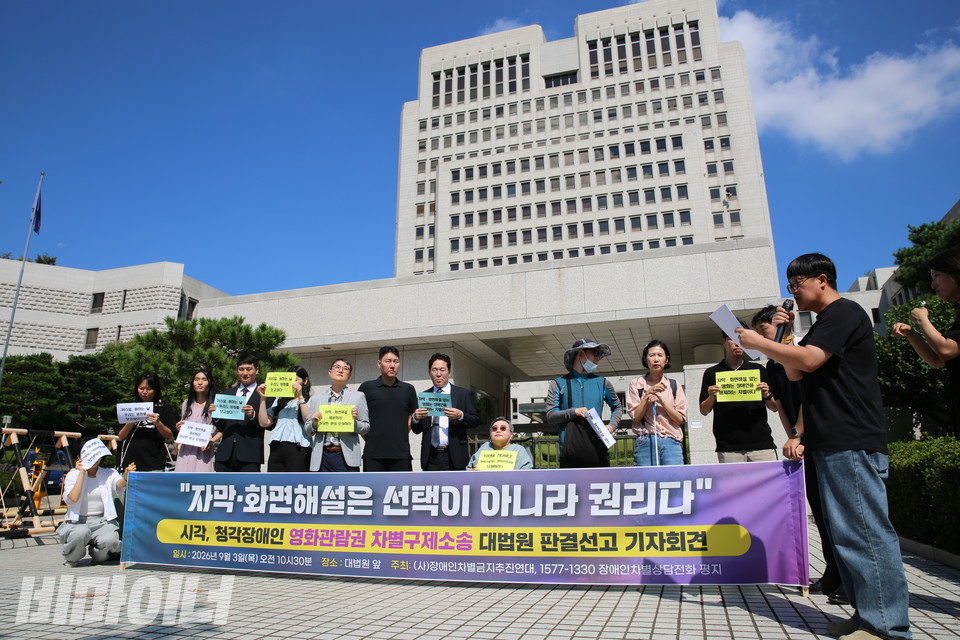
▲ The Solidarity Against Disability Discrimination holds a press conference in front of the Supreme Court at 10 a.m. on the 3rd following the Supreme Court’s ruling on a discrimination lawsuit concerning the movie-going rights of people with visual and hearing disabilities. Photo by Kim So-young. Source: BeMinor (https://www.beminor.com/news/articleView.html?idxno=30375)
A Movie Theater Everyone Can Enjoy: Accessibility for People with Visual and Hearing Disabilities
When we watch a movie at a theater, we follow the story by watching what happens on screen, listening to the dialogue, and reading subtitles.
But for people who have difficulty seeing the screen, audio description may be needed to explain what is happening visually. For people who have difficulty hearing, captions may be needed to convey dialogue and other important sounds.
So, if these forms of support are not available and someone cannot fully enjoy a movie, is it simply an inconvenience?
The Supreme Court Rules That Failing to Provide Audio Description and Captions Can Constitute Discrimination
Recently, the Supreme Court of Korea established an important standard in a case concerning movie theater accessibility for people with visual and hearing disabilities.
The lawsuit was filed by two people with visual disabilities and two people with hearing disabilities, who requested that movie theaters provide the audio description, captions, and other accommodations they need to watch movies.
The Supreme Court upheld the ruling that a movie theater operator’s failure to provide audio description, captions, and the necessary equipment and servers to access them constitutes discrimination prohibited under Korea’s Act on the Prohibition of Discrimination against Persons with Disabilities.
However, the Court determined that a specific standard set by the appellate court—requiring theaters with 300 or more seats to provide screenings with audio description and captions for 3% of their total screenings—needed to be reconsidered.
This ruling goes beyond simply asking whether audio description or captions should be added. It reminds us that for everyone to be able to choose and enjoy movies, people need an environment where they can access content in the ways that work for them.
Accessibility Also Matters in How Court Decisions Are Communicated
There was another noteworthy development in this case.
For the first time, the Supreme Court of Korea provided an Easy Read version of its judgment, helping the people directly involved in the case understand the decision more easily.
Have you ever tried reading a court judgment?
Court decisions often contain long sentences, unfamiliar legal terminology, and complex expressions, making them difficult to understand for people without a legal background. And when a judgment directly concerns your own rights, simply having access to the document is not enough. You should also be able to understand what that decision means for you.
Easy Read is an approach that makes complex information easier to understand by using plain, everyday language and supportive visuals.
In this case, the Supreme Court provided an Easy Read version alongside the original judgment, explaining the most important points in a more accessible way rather than relying solely on complex legal language.
The central message of the ruling was summarized in the Easy Read judgment as follows:
“The movie theaters did discriminate. However, there is a problem with the way the discrimination was ordered to be corrected.”
This makes the key point of the ruling easier to grasp, even for people who may not be familiar with complex legal language.
A Movie Theater Everyone Can Enjoy, and Information Everyone Can Understand
This case highlights two different forms of accessibility.
In movie theaters, cultural accessibility is needed so that people with visual and hearing disabilities can enjoy movies through accommodations such as audio description and captions.
When communicating the court’s decision about those rights, information accessibility is also needed so that the people involved can understand the judgment through formats such as Easy Read and sign language interpretation.
One makes it possible for more people to enjoy movies. The other makes it possible for more people to understand important information.
Although they apply to different situations, both begin with the same question:
“Is simply providing information or a service enough?”
A movie may be playing in a theater, but without audio description or captions, some people may not be able to fully experience it.
Likewise, a court judgment may be publicly available, but if the language is too difficult, some people may still struggle to understand important information that directly affects them.
Ultimately, accessibility is not only about whether something has been provided. It is about whether people can actually access, use, and understand it.
From Simply “Providing” to Making Information Accessible and Understandable for Everyone
This Supreme Court decision invites us to consider what a movie theater that everyone can enjoy should look like, as well as how important information should be communicated.
The fact that the Supreme Court provided an Easy Read judgment for the first time is especially significant. It shows that even highly specialized information, such as legal decisions, should be communicated in ways that allow the people directly affected to understand what it means.
And this issue is not limited to the law.
In areas closely connected to our everyday lives—including public administration, welfare, finance, healthcare, and disaster information—complex language and technical terminology can make essential information difficult for some people to understand.
That is why, when creating information, we can ask one more question:
“Can everyone access and understand this information?”
Just as accessibility helps create an environment where everyone can enjoy movies, making essential information understandable and usable for everyone is also an important part of accessibility.
At EQ4ALL, we will continue exploring ways to make information more accessible through Easy-to-Understand Information and other approaches to information accessibility.






▲ The Solidarity Against Disability Discrimination holds a press conference in front of the Supreme Court at 10 a.m. on the 3rd following the Supreme Court’s ruling on a discrimination lawsuit concerning the movie-going rights of people with visual and hearing disabilities. Photo by Kim So-young. Source: BeMinor (https://www.beminor.com/news/articleView.html?idxno=30375)
A Movie Theater Everyone Can Enjoy: Accessibility for People with Visual and Hearing Disabilities
When we watch a movie at a theater, we follow the story by watching what happens on screen, listening to the dialogue, and reading subtitles.
But for people who have difficulty seeing the screen, audio description may be needed to explain what is happening visually. For people who have difficulty hearing, captions may be needed to convey dialogue and other important sounds.
So, if these forms of support are not available and someone cannot fully enjoy a movie, is it simply an inconvenience?
The Supreme Court Rules That Failing to Provide Audio Description and Captions Can Constitute Discrimination
Recently, the Supreme Court of Korea established an important standard in a case concerning movie theater accessibility for people with visual and hearing disabilities.
The lawsuit was filed by two people with visual disabilities and two people with hearing disabilities, who requested that movie theaters provide the audio description, captions, and other accommodations they need to watch movies.
The Supreme Court upheld the ruling that a movie theater operator’s failure to provide audio description, captions, and the necessary equipment and servers to access them constitutes discrimination prohibited under Korea’s Act on the Prohibition of Discrimination against Persons with Disabilities.
However, the Court determined that a specific standard set by the appellate court—requiring theaters with 300 or more seats to provide screenings with audio description and captions for 3% of their total screenings—needed to be reconsidered.
This ruling goes beyond simply asking whether audio description or captions should be added. It reminds us that for everyone to be able to choose and enjoy movies, people need an environment where they can access content in the ways that work for them.
Accessibility Also Matters in How Court Decisions Are Communicated
There was another noteworthy development in this case.
For the first time, the Supreme Court of Korea provided an Easy Read version of its judgment, helping the people directly involved in the case understand the decision more easily.
Have you ever tried reading a court judgment?
Court decisions often contain long sentences, unfamiliar legal terminology, and complex expressions, making them difficult to understand for people without a legal background. And when a judgment directly concerns your own rights, simply having access to the document is not enough. You should also be able to understand what that decision means for you.
Easy Read is an approach that makes complex information easier to understand by using plain, everyday language and supportive visuals.
In this case, the Supreme Court provided an Easy Read version alongside the original judgment, explaining the most important points in a more accessible way rather than relying solely on complex legal language.
The central message of the ruling was summarized in the Easy Read judgment as follows:
“The movie theaters did discriminate. However, there is a problem with the way the discrimination was ordered to be corrected.”
This makes the key point of the ruling easier to grasp, even for people who may not be familiar with complex legal language.
A Movie Theater Everyone Can Enjoy, and Information Everyone Can Understand
This case highlights two different forms of accessibility.
In movie theaters, cultural accessibility is needed so that people with visual and hearing disabilities can enjoy movies through accommodations such as audio description and captions.
When communicating the court’s decision about those rights, information accessibility is also needed so that the people involved can understand the judgment through formats such as Easy Read and sign language interpretation.
One makes it possible for more people to enjoy movies. The other makes it possible for more people to understand important information.
Although they apply to different situations, both begin with the same question:
“Is simply providing information or a service enough?”
A movie may be playing in a theater, but without audio description or captions, some people may not be able to fully experience it.
Likewise, a court judgment may be publicly available, but if the language is too difficult, some people may still struggle to understand important information that directly affects them.
Ultimately, accessibility is not only about whether something has been provided. It is about whether people can actually access, use, and understand it.
From Simply “Providing” to Making Information Accessible and Understandable for Everyone
This Supreme Court decision invites us to consider what a movie theater that everyone can enjoy should look like, as well as how important information should be communicated.
The fact that the Supreme Court provided an Easy Read judgment for the first time is especially significant. It shows that even highly specialized information, such as legal decisions, should be communicated in ways that allow the people directly affected to understand what it means.
And this issue is not limited to the law.
In areas closely connected to our everyday lives—including public administration, welfare, finance, healthcare, and disaster information—complex language and technical terminology can make essential information difficult for some people to understand.
That is why, when creating information, we can ask one more question:
“Can everyone access and understand this information?”
Just as accessibility helps create an environment where everyone can enjoy movies, making essential information understandable and usable for everyone is also an important part of accessibility.
At EQ4ALL, we will continue exploring ways to make information more accessible through Easy-to-Understand Information and other approaches to information accessibility.