Public information should be understandable to everyone it is meant for.
[ Why Is This Needed? ]
Pension documents carry information with real consequences when it is missed — payment dates and methods, or changes in personal status that have to be reported on time.
Yet these documents are usually provided only as text and forms, which has often made them hard to follow accurately for deaf people who use sign language as their first language. Public information does its job only when it reaches people in a language they understand. Providing that information in sign language, then, is not an optional add-on; it is a basic requirement for delivering the right to information.
The AI sign language translation service that the Government Employees Pension Service (GEPS) launched on 25 August 2026 is exactly such a case.
[ How Is It Used? ]
Four pension documents, delivered through an AI-powered sign language avatar
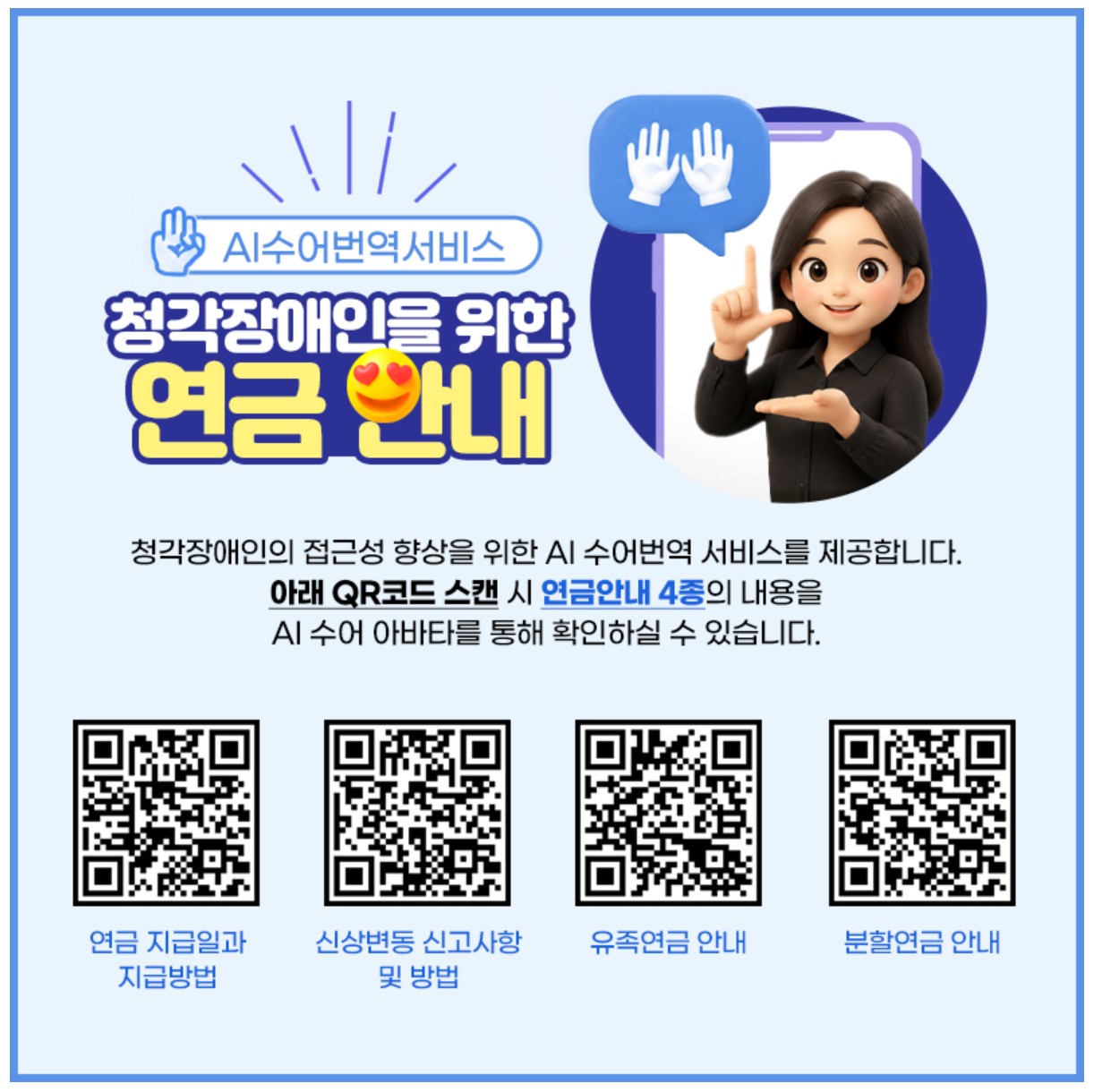
▲ Notice image for the AI sign language translation service (Source: Government Employees Pension Service)
Since 25 August 2026, GEPS has been translating text-based documents into avatar sign language using EQ4ALL's SignTong technology. By scanning the QR codes on the notice, users can view four documents through a sign language avatar: pension payment dates and methods, reporting changes in personal status, survivors' pension guidance, and divided pension guidance.
→ Deaf people can check what they need at the moment they need it, without waiting at a counter or arranging an interpreter.
Expanding to 11 documents within the year
GEPS plans to extend the service to 11 items in total this year, covering key notices and civil application forms. Sign language videos are produced document by document, so a revised notice or a newly added form can be updated or expanded in the same way.
→ Rather than ending as a one-off project, it is a structure that keeps widening sign language access.
Go to SignTong Web
[ What Changes? ]
Better access to public information
Deaf and hard of hearing users can read pension documents directly in sign language.
- A structure that expands document by document
Notices and forms can be updated and expanded in sequence, as needed. Lighter load on frontline services
Less need to repeat the same explanation or to arrange interpretation case by case.
The right to information, put into practice
Not a campaign message, but accessibility applied to the documents people actually use.



Public information should be understandable to everyone it is meant for.
[ Why Is This Needed? ]
Pension documents carry information with real consequences when it is missed — payment dates and methods, or changes in personal status that have to be reported on time.
Yet these documents are usually provided only as text and forms, which has often made them hard to follow accurately for deaf people who use sign language as their first language. Public information does its job only when it reaches people in a language they understand. Providing that information in sign language, then, is not an optional add-on; it is a basic requirement for delivering the right to information.
The AI sign language translation service that the Government Employees Pension Service (GEPS) launched on 25 August 2026 is exactly such a case.
[ How Is It Used? ]
Four pension documents, delivered through an AI-powered sign language avatar
▲ Notice image for the AI sign language translation service (Source: Government Employees Pension Service)
Since 25 August 2026, GEPS has been translating text-based documents into avatar sign language using EQ4ALL's SignTong technology. By scanning the QR codes on the notice, users can view four documents through a sign language avatar: pension payment dates and methods, reporting changes in personal status, survivors' pension guidance, and divided pension guidance.
→ Deaf people can check what they need at the moment they need it, without waiting at a counter or arranging an interpreter.
Expanding to 11 documents within the year
GEPS plans to extend the service to 11 items in total this year, covering key notices and civil application forms. Sign language videos are produced document by document, so a revised notice or a newly added form can be updated or expanded in the same way.
→ Rather than ending as a one-off project, it is a structure that keeps widening sign language access.
Go to SignTong Web
[ What Changes? ]
Better access to public information
Deaf and hard of hearing users can read pension documents directly in sign language.
Notices and forms can be updated and expanded in sequence, as needed.
Lighter load on frontline services
Less need to repeat the same explanation or to arrange interpretation case by case.
The right to information, put into practice
Not a campaign message, but accessibility applied to the documents people actually use.